
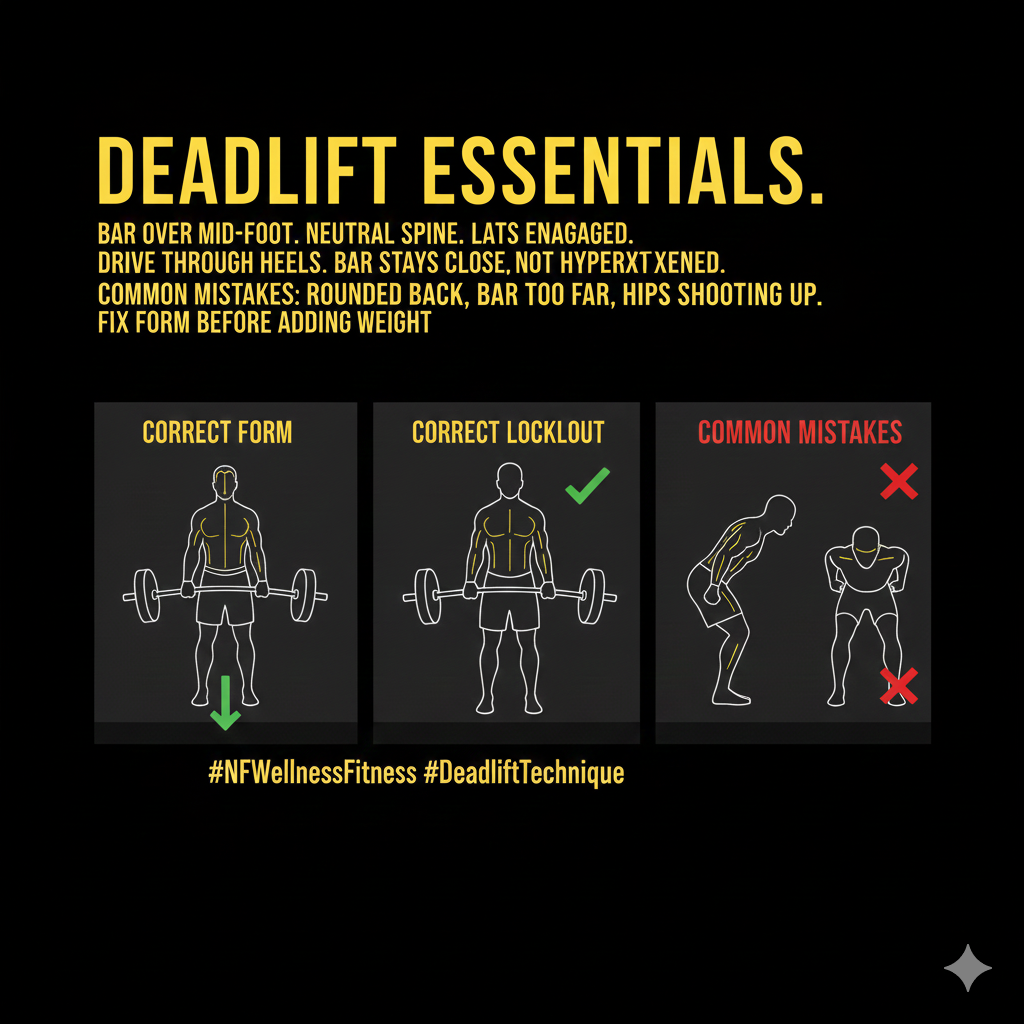
The deadlift is one of the most effective exercises in existence. It builds total-body strength, targets the posterior chain (glutes, hamstrings, lower back), improves grip strength, and translates directly to real-world function (picking things up off the ground).
It’s also one of the most commonly butchered movements in the gym.
Poor deadlift form doesn’t just limit your progress—it increases injury risk, particularly to the lower back. Master the movement pattern, and you’ll build strength safely for decades. Rush it, and you’ll end up sidelined.
This guide breaks down proper deadlift technique, coaching cues, and the mistakes that sabotage your lift.
The Conventional Deadlift Setup:
Step 1: Foot Position
- Feet hip-width apart (roughly 6-10 inches between heels)
- Toes pointing slightly outward (5-15 degrees)
- Bar positioned over mid-foot (not toes, not heels—directly over the middle)
Step 2: Grip
- Hands just outside your legs (shoulder-width or slightly wider)
- Two grip options:
- Double overhand (both palms facing you) — best for grip strength development
- Mixed grip (one palm facing you, one away) — allows heavier loads but can create imbalances over time
- Grip the bar hard. Squeeze like you’re trying to leave fingerprints in the steel.
Step 3: Hip and Shoulder Position
- Hinge at the hips to reach the bar
- Shoulders directly over the bar or slightly in front
- Hips higher than knees, lower than shoulders
- Key cue: You should feel tension in your hamstrings before you pull
Step 4: Spine Position
- Neutral spine from head to tailbone
- Chest up, shoulders back
- Do not round your lower back
- Engage your lats by “bending the bar” (pulling it toward you without lifting it)
Step 5: Bracing
- Take a deep breath into your belly (diaphragmatic breathing)
- Brace your core as if someone is about to punch you in the stomach
- Hold this tension throughout the lift
The Lift Execution:
Phase 1: The Pull (Concentric)
- Drive through your heels
- Extend your knees and hips simultaneously
- Keep the bar close to your body (it should almost drag up your shins and thighs)
- Do not jerk the bar—create tension, then pull smoothly
- As the bar passes your knees, drive your hips forward (hip extension)
- Stand tall at the top: shoulders back, chest up, glutes squeezed
- Do not hyperextend your lower back at lockout
Phase 2: The Descent (Eccentric)
- Reverse the movement: hinge at the hips first, then bend the knees
- Control the bar on the way down—don’t just drop it (unless you’re training maximal loads in a powerlifting environment)
- Keep the bar close to your body
- Return the bar to the ground, reset your position, and repeat
Common Mistakes and Fixes:
Mistake #1: Rounded Lower Back
- Problem: Puts excessive stress on spinal discs, increases injury risk
- Fix: Reduce the weight. Focus on maintaining neutral spine throughout. If you can’t keep a flat back, the load is too heavy or your setup is wrong.
Mistake #2: Bar Too Far From Body
- Problem: Creates a longer lever arm, increasing lower back strain and making the lift harder
- Fix: Keep the bar against your shins and thighs. Think: “scrape your legs.”
Mistake #3: Hips Shooting Up First
- Problem: Turns the deadlift into a stiff-legged deadlift, placing all the load on the lower back instead of distributing it across the posterior chain
- Fix: Drive through your heels and extend knees and hips together. Film yourself from the side to check.
Mistake #4: Not Engaging the Lats
- Problem: Allows the bar to drift forward, reduces pulling power
- Fix: “Bend the bar” by pulling it toward you before you lift. This engages your lats and keeps the bar close.
Mistake #5: Hyperextending at the Top
- Problem: Excessive backward lean at lockout stresses the lower back unnecessarily
- Fix: Stand tall with glutes squeezed, but don’t lean backward. Lockout is achieved when hips and knees are fully extended, not when you’re leaning back.
Deadlift Variations:
Sumo Deadlift
- Wider stance, toes pointed out more
- Hands inside your legs
- Emphasizes quads and adductors more than conventional
- Good option for lifters with longer torsos or hip mobility limitations
Romanian Deadlift (RDL)
- Starts from standing position
- Minimal knee bend
- Emphasizes hamstrings and glutes
- Excellent accessory movement for posterior chain development
Trap Bar Deadlift
- Uses a hexagonal bar that you stand inside
- More quad-dominant, less lower back stress
- Great for beginners or those with back issues
Programming the Deadlift:
For Beginners:
- 3 sets of 5 reps, 2x per week
- Focus on form, not weight
- Add 5-10 lbs per week as long as form stays clean
For Intermediate Lifters:
- 4-5 sets of 3-5 reps, 1-2x per week
- Incorporate RDLs or sumo deadlifts as accessory work
- Progressive overload: add weight when you can complete all sets with perfect form
For Advanced Lifters:
- Periodized programming (wave loading, block periodization)
- Vary intensity and volume across training cycles
- Include heavy singles, speed work, and high-rep accessory work
The deadlift is a skill. Treat it like one. Master the setup, refine your technique, and respect the process.
Lift heavy. Lift smart. Build strength that lasts.
Wellness is the way.
Discover more from NO FEELINGS WELLNESS FITNESS
Subscribe to get the latest posts sent to your email.